725 Fifth Avenue, 23rd Floor
New York, NY 10022


The Iran war has caused well-documented price spikes and shortages on a range of items Americans depend upon. Oil and gas, of course, but also petrochemicals and everything derived from them (e.g. plastics) and helium are among raw materials that have been besieged by the closure of the Strait of Hormuz. Still, there is another element which has seen its price surge amid increasingly short supply because of war, but where the shock will not relent even if the Strait is reopened. The vast amount of U.S. munitions used in battle combined with weapons shipped to Ukraine has left many U.S.-based entities in search of tungsten.
If you don’t know you need tungsten, that’s understandable. While tungsten’s role in weapons is driving the current crisis, its reach extends to far more mundane corners of American life, from the dentist’s chair to the fishing hole. It flies under the radar for most people, but not those within supply chains where it is critical.
“The tungsten topic comes up in almost every vendor conversation,” said Mark Vena, CEO and principal analyst at SmartTech Research. “Tungsten is the metal nobody talks about until missiles, factories, and machine shops all need it at the same time,” Vena said, noting that it connects warfighting, manufacturing, electronics, aerospace, EVs, and everyday tools. Vena described the current situation as “one ugly supply chain knot” and said the tungsten crisis is a reminder that for all of AI’s and tech’s advancement, the economy is still dependent on physical materials.
As with other situations involving rare earth materials in recent years, China looms large in the supply chain bottleneck. China is the dominant supplier, controlling as much as 80% of the world’s tungsten, though its production is on the decline. It clamped down on exports back in February 2025, citing national security concerns, and it continues to subject the metal to tight export controls.
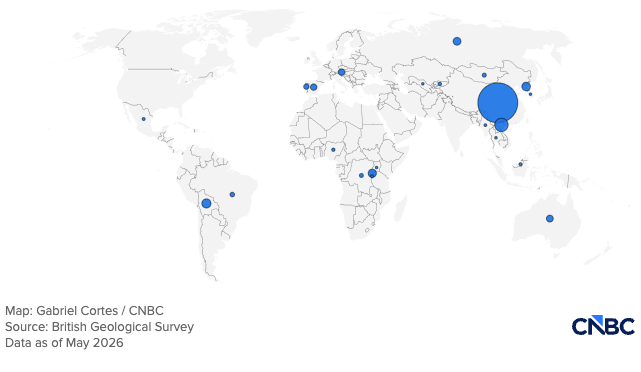
According to the most recent USGS data, global tungsten production reached approximately 81,000 metric tons in 2024, with Vietnam a distant second to China. The U.S. produces virtually none domestically.
Metric tons produced in 2024
China and Vietnam account for more than 80% of the world's tungsten production.
China’s outsize role in the market has attracted the attention of policymakers for years. In 2022, the U.S. REEShore Act was introduced and included a prohibition on the use of Chinese tungsten in military equipment starting in 2026, but it was never passed into law. The Department of Defense does have new sourcing rules coming into effect which will require new sources of the metal.
Among new sources of tungsten in the works is a mining operation being set up in Kazakhstan for its untapped reserves by Cove Kaz Capital, a portfolio holding of mining company Cove Capital. “The tungsten industry is experiencing unprecedented market conditions,” said Cove Kaz Capital Executive Chairman Pini Althaus. “Soaring prices are because of scarce supply due to the drawdown of global tungsten reserves as a result of the wars in Ukraine and Iran,” he said.
Cove Kaz Capital has attracted attention for another reason: both Eric Trump and Donald Trump Jr. are investors in a company planning to merge with it.
As tungsten output from China has decreased after decades of mining and extraction, it is more frequently purchasing tungsten concentrates from other countries at premiums to feed its own processing facilities and for its own defense, industrial, and energy needs. At the same time, U.S. demand for tungsten over the next five to ten years will require multiple new tungsten mines in production globally, Althaus said.
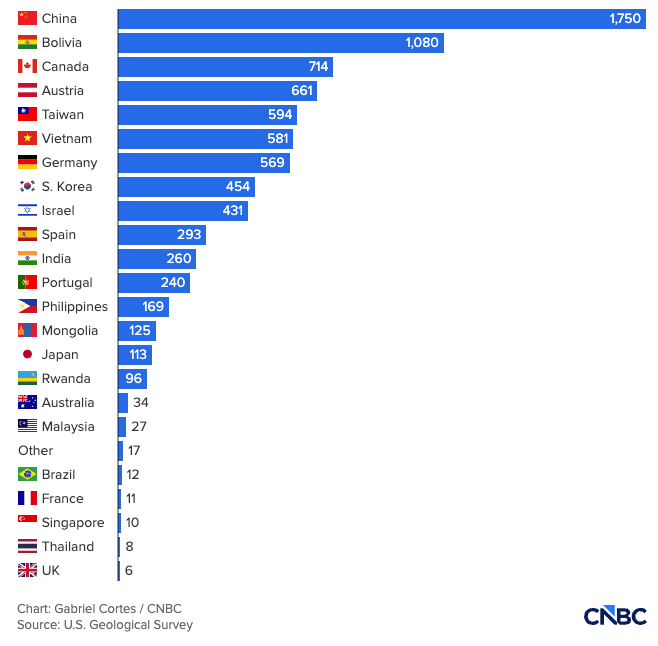
Tungsten reserves worldwide
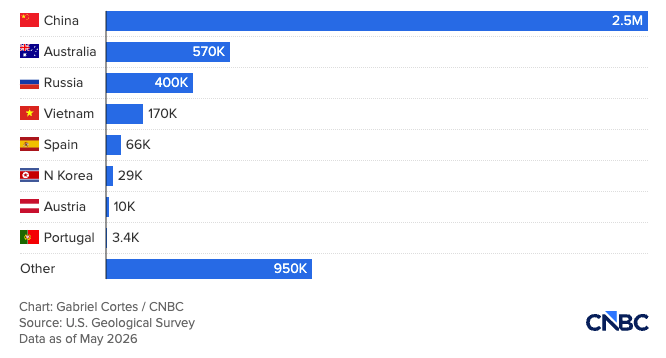
Kazakhstan is just one front in the emerging tungsten war. One of the most aggressive players is Almonty Industries, a Canada-based miner that completed Phase 1 commissioning of its Sangdong Tungsten Mine in South Korea’s Gangwon Province in March, marking the deposit’s return to production after more than 30 years. The company also operates a producing mine in Portugal. These will eventually help to alleviate supply issues.
The United States is also on Almonty’s radar, according to CEO Lewis Black. “There hasn’t been any mining in the U.S. for tungsten in 30 years,” Black told CNBC late last year. He said it is difficult to develop domestic mines that scale like some of the operations overseas, but that pursuing U.S. supply “makes good sense for customers and defense work.”
Both the United States and Europe are replenishing weapons and munitions that require tungsten, for among other uses, armor-piercing ammunition. But Althaus said that the simultaneous wars are depleting tungsten stocks and forcing U.S. tungsten refiners to feed their plants with a limited combination of scrap, recycled materials, and ore concentrates. The wars are projected to compound shortfalls in overall tungsten supply as defense demand grows.
“All told, the U.S. will require greater supplies of sustained and scaled tungsten well into the 2030s,” Althaus said.
Cove Capital is working with estimates coming in from the marketplace that as high as 20,000 metric tons annually will be needed in the U.S. alone, not including the National Defense Stockpile and Project Vault.
At full scale, Cove Kaz’s tungsten project in Kazakhstan is projected to produce 12,000 metric ton per year. Department of Defense sourcing rules that become effective January 1, 2027, will restrict the use of tungsten metal powders and heavy alloys mined, refined, and produced in China.
Cove Kaz’s investment is predicated on a belief that Kazakhstan’s tungsten reserves will have a lifespan that outlasts many political cycles. The project’s two open-pit tungsten reserves are expected to operate for 50-plus years, or as Althaus framed it, “the next ten to twelve American presidencies.”
Planned production would equal roughly 15 percent of current annual mine output globally, based on the roughly 80,000 metric tons produced currently.
“Our aim presently is to finalize engineering studies and mine and refinery construction plans and break ground in the next eighteen months,” Althaus said, though he did not provide a timeline for when the project would reach full-scale production.
The Kazakhstan deal has drawn scrutiny because Donald Trump Jr. and Eric Trump invested in a company called Skyline Builders Group in August 2025, with the company planning to evolve from a legacy Asia-based construction firm to a focus on critical material supply chain investments. The company merged with Cove Kaz Capital on April 30 and expects to trade as Kaz Resources once the deal is completed in late 2026 or early 2027. The exact size of their investment is not known.
Lawmakers and watchdog groups have been scrutinizing deals involving the president’s family. Rep. Robert Garcia (D-Calif.), ranking member of the House Committee on Oversight and Accountability, has called on the Defense Department’s inspector general to investigate multiple transactions involving Trump family members and related to national security. To date, the DoD has not responded.
A Trump Organization spokeswoman said the Trump family had no involvement in the merger transaction and has always been a passive investor in Skyline Builders Group with no management role.
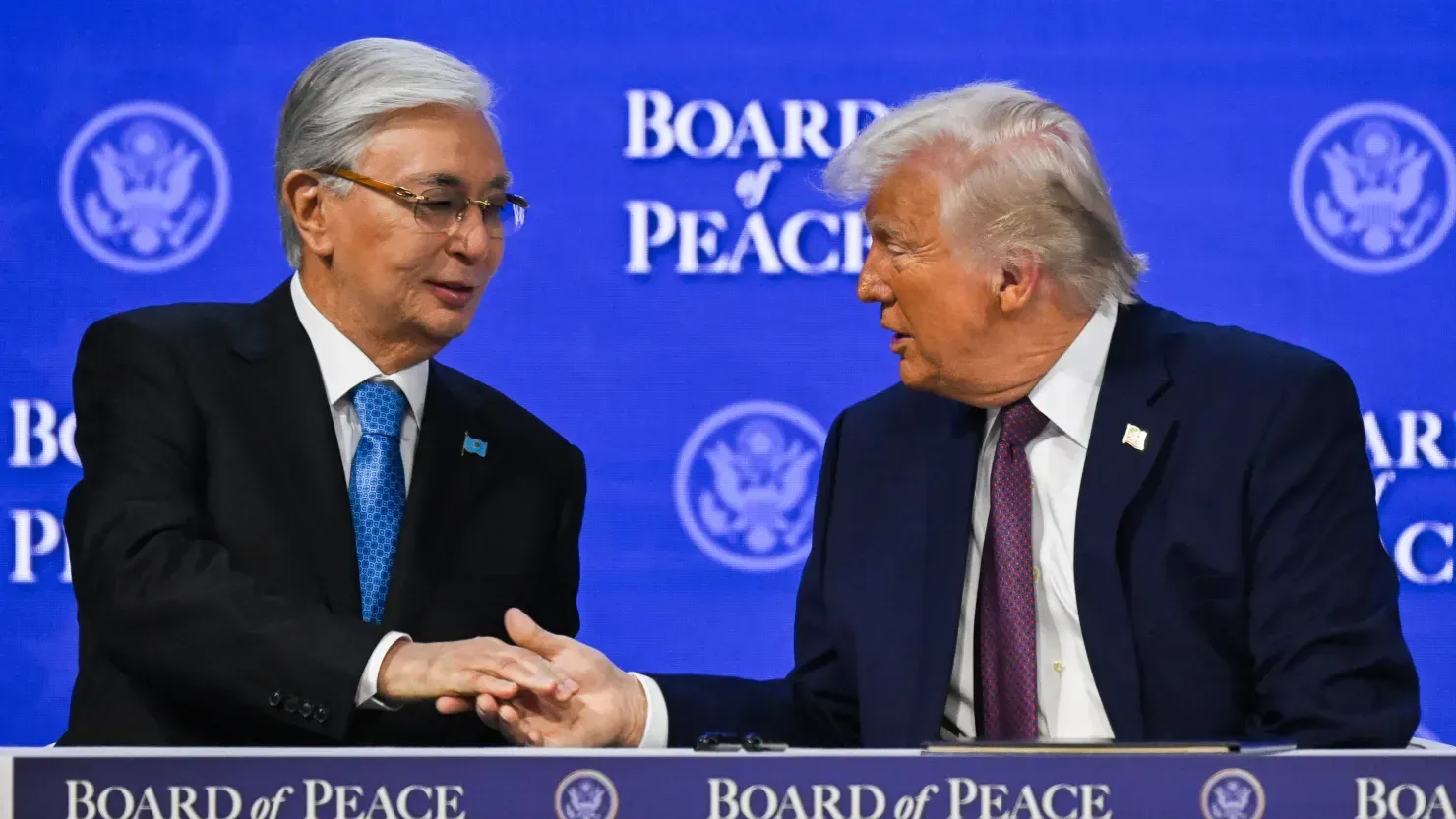
U.S. President Donald Trump (R) and Kazakh President Kassym-Jomart Tokayev attend the Peace Council meeting held during the 56th World Economic Forum in Davos, Switzerland on Jan. 22, 2026.
Harun Ozalp | Anadolu | Getty Images
The U.S. government has thrown its weight behind the hunt for additional sources of tungsten, committing up to $1.6 billion through the Export-Import Bank and the U.S. International Development Finance Corporation to the Cove Kaz project, including a $900 million commitment last November and a $700 million commitment in February of this year. The FT, which first reported on the Trump family investment related to the mining project, recently reported that Cove Kaz Capital has requested an additional $400 million from the Department of Defense.
The government had been laying the groundwork for tungsten investment before the start of the second Trump administration. Cove Kaz noted in its acquisition announcement that the U.S Departments of Commerce and State have been supporting efforts to access Kazakhastan’s tungsten sources since 2023, spanning the Biden and Trump administration. Cove Kaz also referenced a joint venture struck between President Trump and Kazakhstan’s President Kassym-Jomart Tokayev which included the tungsten mining assets.
Whatever happens in Kazakhstan, the tungsten shortage will continue to be felt until new supplies can be procured, and it will impact Americans in one way or another.
“For most consumers, tungsten is kind of invisible to them. But it keeps the machines and tools that keep this economy going, so they’re going to feel it that way,” said Evan Mills, a financial analyst at wealth planning firm Scholar Advising who specializes in commodities and metals investments.
“Now these Western countries are at war, they need tungsten more than ever — whether it’s for weapons or just basic industrial tools — and it just so happens that the biggest distributor decided to stop distributing right at that moment. That’s the main concern,” Mills said. “There’s still a fairly good-sized supply of this out there — it’s just getting harder and harder to get it from a country that doesn’t necessarily want to distribute it anymore.”
Mills said that consumers aren’t buying tungsten directly, so the shortage won’t show up directly on their own balance sheet. “But they’ll certainly pay for it when there are delays in construction, when construction costs more, when the machines behind mining and drilling and manufacturing start getting more expensive to run,” Mills said, citing drill bits, saws, and industrial equipment.
He said few people dwell on these critical materials until they become a serious national security threat, “and that’s what this is,” he added.
Dr. Elizabeth Sterner, assistant professor of chemistry at Lebanon Valley College with expertise in polymer chemistry, said there are everyday items affected by a tungsten shortage, including dental drills. Those in the dental chair can be especially grateful for tungsten. “Tungsten carbide tips dental drills, making them more efficient and causing patients less discomfort,” Sterner said.
And while tungsten may not be found directly in your smartphone, computer, or car, it does play a role in making them — tungsten carbide drills are used to fabricate the circuit boards in most electronic devices.
If you cast your line in your favorite fishing hole and came away with a good haul, thank tungsten. “Tungsten weights are used in fishing because they are less toxic than lead weights,” Sterner said.
“Prices for all of these items may increase if there is a tungsten shortage, both due to the lack of tungsten itself and the lack of tungsten carbide machining tools that make these products,” she added.

Dominari Securities provides clients access to products and services offered through bank and non-bank affiliates.
Securities and Registered Investment Advisory Services offered through Dominari Securities, LLC, an SEC registered investment advisor and broker-dealer. Member, FINRA, MSRB and SIPC.
Securities, brokerage, investment advisory and other non-deposit investment products: Are not FDIC insured - Are Not Bank- Guaranteed - May Lose Value, Including The Principal Invested. Check the background of Dominari Securities and our investment professionals on FINRA’s Broker Check.
Check the background of Dominari Securities and our investment professionals on FINRA’s Broker Check.
We’re here to help you navigate the complexities of modern finance. Reach out today to begin a conversation that could shape your financial future.

725 Fifth Avenue, 23rd Floor
New York, NY 10022

(212) 393-4500
(800) 299-7618

info@dominarisecurities.com
©2025 Dominari Securities LLC | All Rights Reserved.